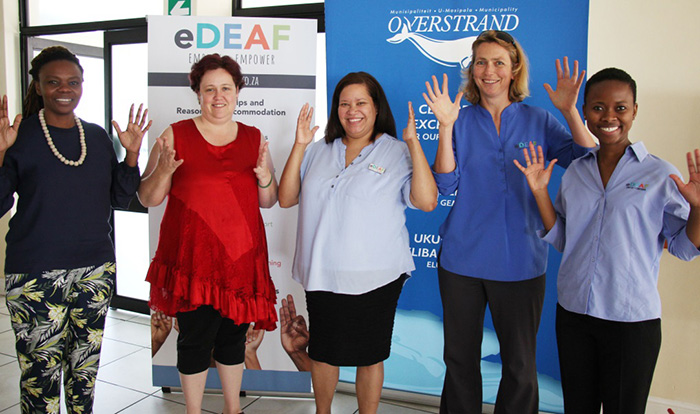
Overstrand Municipal officials ‘listened’ in quiet wonder to Leigh McDonald-Dyers’s inspiring address to make all hearing South Africans aware of - or at least sensitive to - the needs of people who are deaf and hard of hearing.
Deaf people normally communicate by lip reading or sign language but “Deaf people love technology” and it became a game-changer as modern day resources assist them to communicate with others.
“Being deaf is not a disability but rather a unique culture and something that adds diversity to our country. I want you to learn how to communicate with us,” Leigh said via sign language interpreter Dimakatso Motimele.
These two ladies are working for eDEAF (acronym for Employ and Empower Deaf), a company that aims to empower the deaf community to be business ready.
They shared some interesting fundamental facts about deafness and sign-language, and the following tips might be helpful:
- If you want to communicate with a deaf person, first attract his or her attention by tapping gently on their shoulder to establish eye contact or wave if they are out of reach
- Establish a comfortable distance between you and the deaf person
- Do not shout or mumble - just speak normally
- Establish eye contact before initiating communication
- Wait for your turn before signing/speaking
- Keep the face clear of any obstruction and don’t overdo facial expressions
- Don’t stand with your back against the light.
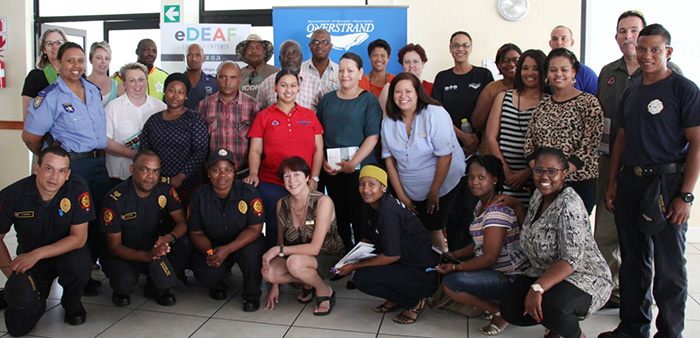
eDeaf promotes integration of the Deaf community into schools and the workplace. They created a free smart phone application that boasts with almost 6 000 South African Sign Language (SASL) signs. The aim of this app is to bridge the communication gap between deaf and the hearing by allowing the user to search for and ‘translate’ a word or specific phrase.
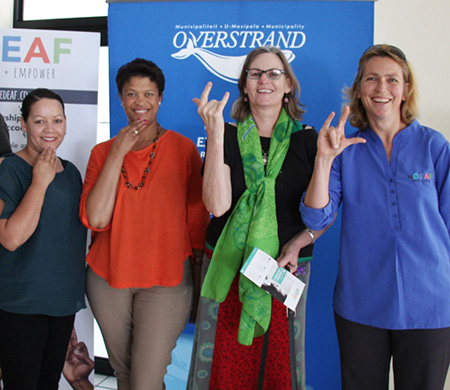
In addition to this, eDeaf offers a number of training courses and programmes to “Empower Deaf communities for business”, including adult education and training programmes, wholesale and retail learnerships, IT training and SASL training.
Should there be interested residents and/or businesses (20 or more) who would be interested in sign language training, eDeaf would consider coming to the Overstand to do the training.
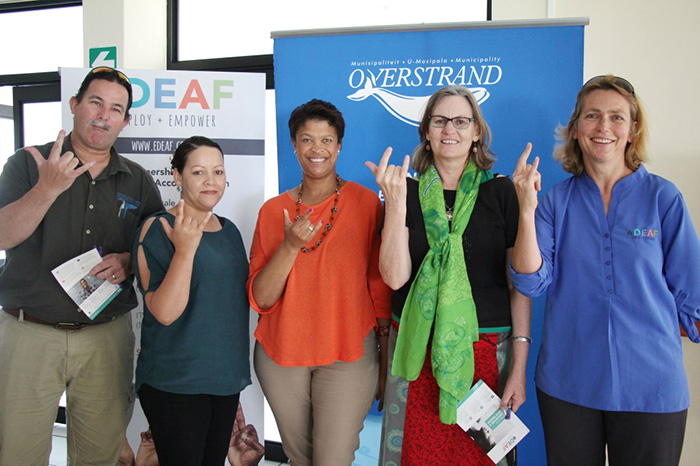
Many deaf people do not have matric, and many companies request a National Senior Certificate to be eligible for employment, eDeaf can also assist learners to obtain an SETA accredited learnership on an NQF level 4 that is equivalent to grade 12.
For more information regarding eDeaf programmes and learnerships, please contact Mariska de Beer on 082 925 1981 or email: This email address is being protected from spambots. You need JavaScript enabled to view it..